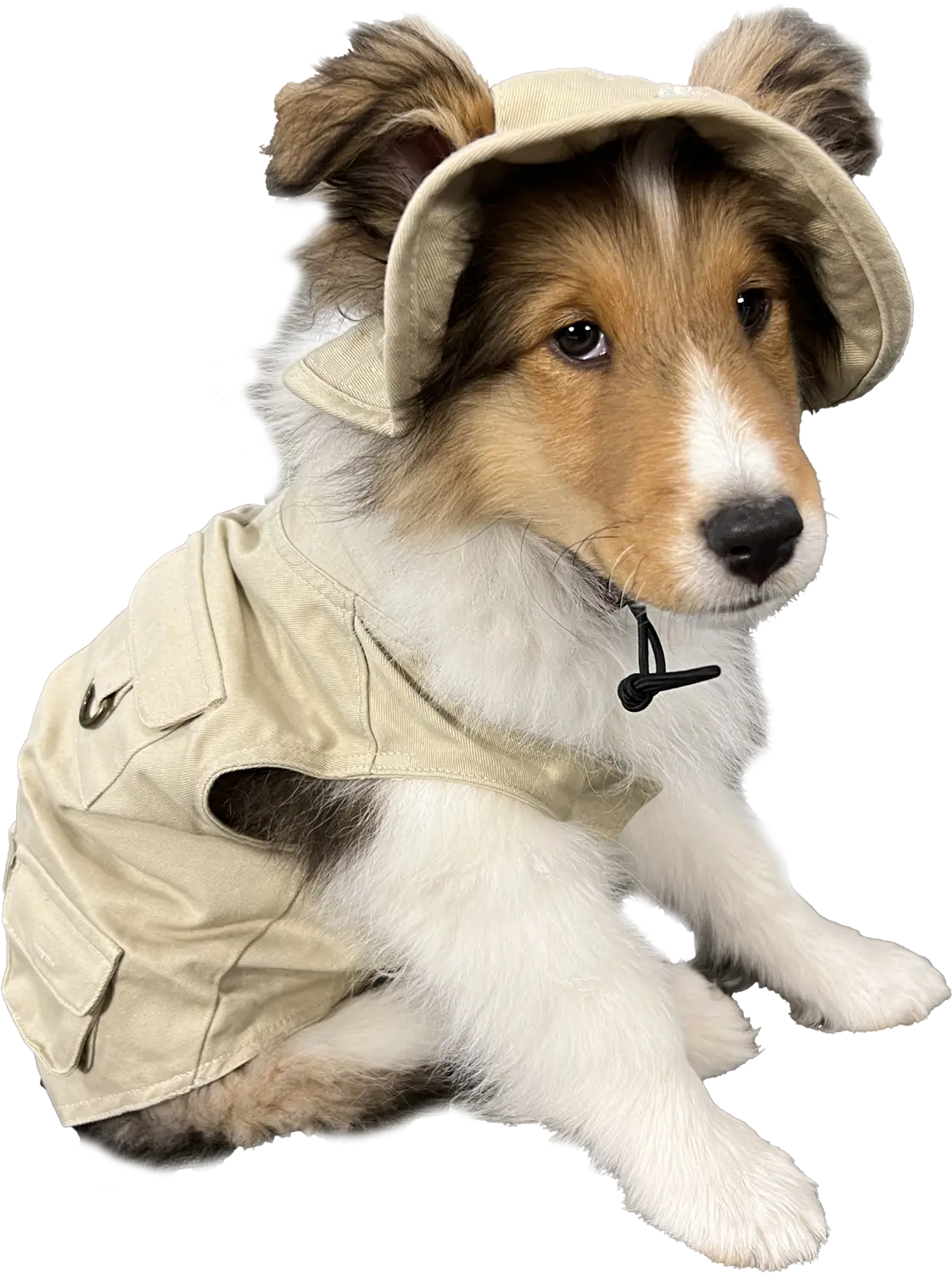
Three Shelties. One house. A full committee of opinions.
The Chronicles Newsletter publishes the First and Third Thursday of every month.

Ticks do not care whether your dog is a tiny Chihuahua, a curly-coated Doodle, a Labrador or a gloriously fluffy Sheltie. They are patient, persistent and remarkably unimpressed by “No Trespassing” signs.
Some coats simply make their work easier. A tick on a short-haired dog may be spotted quickly. A Sheltie’s thick double coat provides considerably more privacy—rather like checking into a furnished apartment with room service.
Biscuit would classify a tick as an unauthorized tenant. Cricket would call it a health violation. Kevin would probably give it a name. The correct response is less entertaining: prevent ticks when possible, find them quickly and remove them properly.
Not All Ticks Are the Same
“Wood tick” is often used as a general name, but several species can attach to dogs. In Ontario, these include the American dog tick and the smaller blacklegged tick. Lyme disease is transmitted by infected blacklegged ticks, while other species can carry different illnesses. Identification can be useful, but every attached tick deserves prompt removal.

Avoiding Tick Encounters
Ticks cannot fly or jump. They wait on grasses and shrubs for a dog—or a human—to brush past. On walks, stay on marked trails and keep your pup away from tall grass, dense brush and piles of leaves. At home, mow regularly, remove leaf litter and weeds, trim vegetation near frequently used areas and move woodpiles away from the house.
Check both dog and human after outdoor adventures. Ticks can become active when temperatures reach approximately 4°C, so a warm winter day is not necessarily tick-free. The Ontario Veterinary Medical Association recommends full-body checks after walks, particularly around the head, neck and paws.
Prevention That Works
Ask your veterinarian about a tick preventive suited to your dog’s age, weight, health and lifestyle. Options include oral chews, topical treatments and tick collars. Follow the schedule precisely; “almost every month” creates gaps that ticks are delighted to exploit. Never apply a dog-only product to a cat.
Veterinary parasite experts recommend consistent protection, often year-round where exposure is possible. Preventives greatly reduce risk but do not eliminate the need for inspections; some products kill ticks only after they attach. For dogs with significant exposure in Lyme-risk areas, ask whether Lyme vaccination is appropriate. Vaccination adds another layer of protection but does not replace tick control. The Companion Animal Parasite Council recommends year-round protection because different ticks may be active at different times.
Finding a Tick
Run your fingertips slowly over your dog, feeling for small bumps. Check around the ears and eyelids, under the collar, beneath the front legs, between the back legs, around the tail and between the toes.
With short coats, look closely along the skin. With long, curly or dense coats, separate the hair in sections until you can see the skin. For Biscuit, Cricket and Kevin, this can feel less like a tick check and more like an archaeological excavation. A comb helps part the furnishings, but fingertips are often the better detectors.
How to Remove It
Put on gloves and use clean, fine-point tweezers or a proper tick-removal tool. Grasp the tick as close to the skin as possible, where its mouthparts enter. Pull slowly and steadily straight out. Do not twist, jerk or squeeze its swollen body.
Do not burn the tick or smother it with petroleum jelly, nail polish or essential oils while it is still attached. These methods can irritate it and may increase the release of infected material into the bite. If small mouthparts remain and will not lift easily, do not dig into the skin. Contact your veterinarian if the area becomes irritated.
Wash the bite with soap and water, clean your tool and wash your hands. Photograph the tick and record the date, bite location and where your dog may have picked it up. Submit a clear photograph to eTick for identification, or seal the tick in a container in case your veterinarian wants to examine it. These removal steps follow current Public Health Agency of Canada guidance.

What to Watch For Afterwards
A small bump may remain at the attachment site, but increasing redness, swelling, pain or discharge warrants a veterinary call. Over the following weeks, watch for fever, unusual tiredness, reduced appetite, swollen or painful joints, enlarged lymph nodes or lameness that shifts from one leg to another. Unexplained bruising or nosebleeds can occur with some tick-borne infections.
Most dogs exposed to Lyme bacteria never develop symptoms, but serious kidney complications can occasionally occur. Vomiting, weight loss, increased thirst or changes in urination require prompt veterinary attention.
Do not give leftover antibiotics or human medication. A Lyme antibody test immediately after the bite may be too early; antibodies can take four to six weeks to become detectable. Your veterinarian can decide whether and when testing is appropriate. The MSD Veterinary Manual provides further information about symptoms and diagnosis.
The plan is simple: prevent, inspect, remove and observe.
And do not let Kevin name them. That only makes eviction more difficult.

Today’s Question: “Cricket, why does my dog have to sniff every patch of grass during a walk? We would get home much faster if he just kept moving.”
Cricket’s Answer:
That’s because you think a walk is about travelling from Point A to Point B. Your dog thinks it is time to read the neighbourhood news.
Every tree, lamppost and patch of grass can hold scents left by other animals. Dogs may learn who passed through, how recently they were there and other information that our comparatively unimpressive human noses completely miss.
Sniffing also gives a dog’s brain something to do. Investigating scents can make a short walk mentally satisfying, even when you haven’t travelled very far. Humans may count steps, but dogs count interesting smells.

That does not mean your dog should be allowed to tow you into every bush. You can give a cue such as “go sniff” when it is safe to explore, followed by “let’s go” when it is time to continue. This lets your dog enjoy the walk without turning a ten-minute outing into an overnight expedition.
Biscuit calls sniffing “neighbourhood intelligence gathering.”
Kevin calls it checking his “pee-mail.”
Yesterday, he spent five minutes investigating one particularly important message.
It was a wet leaf.
So be patient when your dog stops to sniff. You may think he is wasting time, but he is simply catching up on everything that happened since his last walk—without needing a group chat. 🐾
Biscuit caught Daddy throwing out one of her ‘art works’. It got ugly fast! See our latest on YouTube!

Show Us What Your Pup Can Do!
Has your dog tried one of the tricks, training exercises or activities featured in The Chronicles? We would love to see the results—whether your pup mastered it immediately or created a technique entirely of their own!
Simply send your photo via email and include:
-
Your pup’s name
-
The trick or skill they are practising
Your pup could be featured in an upcoming edition of Paws in Practice!
Send those pictures to cricket@cricketchronicles.ca
By submitting a photo, you confirm that the pup belongs to you and give The Chronicles permission to publish it in the newsletter. Dogs will be identified by name only unless you request otherwise.
“A dog is the only thing on earth that loves you more than he loves himself.”
Josh Billings
A Note from our Sponsor:
Smart starts here.

You don’t have to read everything — just the right thing. 1440’s daily newsletter distills the day’s biggest stories from 100+ sources into one quick, 5-minute read. It’s the fastest way to stay sharp, sound informed, and actually understand what’s happening in the world. Join 4.5 million readers who start their day the smart way.
Cartoon of the Week!

Want more tips, tricks, and tail-wagging tales? Visit our blog anytime at cricketchronicles.ca!
Until next time,
The Dad, the Mom and all the Pups!
The Chronicles publishes the first and third thursday of every month.
Add your email to get every edition!

1